
Why Your Child Writes Backwards—And Why That’s Actually Normal

When I was young, writing my whole name on my assignments was a lot of work—Elizabeth has a bunch of letters and takes real effort for a Kindergartener to write. My solution was to just put an E instead of my full name. Needless to say, my teacher wasn’t pleased. So I began to write my full name, Elizadeth. That flipping of b to a d made my older friends laugh. After some practice, I flipped that d to a b, and I’ve been spelling my name correctly ever since.
Flipping letters like b and d is a common experience for young children. It is called “mirror writing.”
Here’s what you need to know:
Mirror writing—writing letters or even words backwards—is completely normal in young children. In fact, it’s not a flaw in your child’s development; it’s evidence of an ancient feature in the human brain that’s been helping us survive for millions of years.
Understanding why this happens, when it should resolve, and what to do about it can turn your worry into confidence. Let’s explore what’s really going on in your child’s brain.
Mirror Invariance: Your Brain’s Ancient Superpower
In my previous article on how the brain learns to read, I explained that reading isn’t natural—our brains weren’t designed for it. But there is something our brains were designed to do: recognize objects regardless of their orientation.
Scientists call this ability mirror invariance (or mirror generalization). It’s how our brain recognizes that an object is the same thing no matter which way it’s facing—left or right, forward or backward. This happens in the occipital lobe, the vision center at the back of the brain.
Think about it: A cup is still a cup whether the handle points left or right. Your dog is still your dog whether you see them from the front or back. A car is a car no matter which direction you approach it from. This ability has been crucial for survival. Imagine if our ancestors couldn’t recognize a predator just because it was facing the other direction!
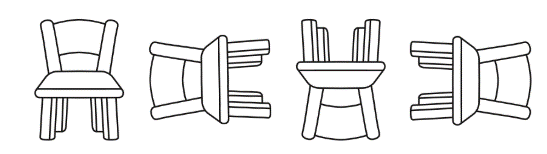
A chair is a chair no matter which direction it is facing.
When a Superpower Becomes a Challenge
Reading and writing are relatively recent human inventions—only about 5,000 years old. Many writing systems, including English, contain letters that are mirror images of each other: b and d, p and q. And even numbers like 3 (if it is flipped it looks like the letter E).
To a child’s brain—which automatically treats flipped shapes as the same—the letters b and d look identical. They’re both a circle with a stick—just flipped around, like seeing that cup with the handle on different sides.
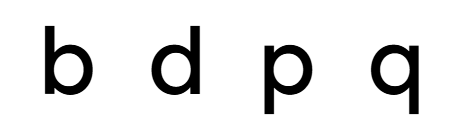
These letters are the same shape but mean different things depending on which way they face.
This is why young children spontaneously produce mirror writing. Learning to read requires children to do something that goes against their brain’s natural wiring: they must unlearn mirror invariance for letters. They need to override an ancient visual mechanism and learn that for these specific symbols—and only these symbols—orientation matters critically.
Breaking Mirror Invariance: How the Brain Adapts
Before learning to read, a special section of the occipital lobe that is repurposed for reading shows strong mirror invariance (letters b and d are treated as identical). But after children learn to read, something remarkable happens. The same brain region that shows maximum mirror invariance for pictures (a cup is a cup, no matter which way the handle points) shows no mirror invariance for letters. The brain learns to discriminate between mirror letters while keeping mirror invariance intact for everything else. The brain is amazing!
How does this happen? As children learn to read, the brain’s reading center gets help from multiple brain systems:
Sound City (parietal lobe) sends phonological information—the b makes a /b/ sound while d makes a /d/ sound. Different sounds = different letters.
Motor areas involved in handwriting send feedback about how the letter is formed—b starts with a line down, then a circle on the right; d starts with a circle, then a line up on the right side.
Speech production areas provide feedback about how your mouth moves—notice how your lips press together for /b/ but the lips stay more rounded and open for /d/.
All these inputs work together to help the brain learn that these visually similar shapes are actually distinct symbols. The learning process truly is multisensory—visual, auditory, and motor systems all contribute to breaking mirror invariance for letters while preserving it for objects.
The Timeline: When Should Mirror Writing Resolve?
Here’s what research tells us about the typical timeline:
Ages 3-5: Mirror writing is extremely common and completely normal
Young children often spontaneously write letters backwards or even write entire words and names from right to left. This is not a cause for concern—it’s evidence that their brain is working exactly as it was designed.
Ages 5-7: Reversals are still typical and should gradually decrease
As children learn to read and practice writing, they begin to override mirror invariance for letters. During kindergarten and first grade, letter reversals should become less frequent. By the end of second grade, most children have largely stopped reversing letters.
Age 8 and beyond: Persistent reversals warrant attention
If a child continues to frequently reverse letters after age 8—particularly if coupled with other reading or learning difficulties—this may signal a need for additional support or evaluation.
Important note: Occasional letter reversals can persist even into adulthood and don’t necessarily indicate a problem. The concern is when reversals are frequent and persistent beyond age 8, especially when they interfere with reading fluency or written expression and are coupled with other learning difficulties.
What About Dyslexia?
Many parents worry that letter reversals mean their child has dyslexia. Let’s set the record straight: Letter reversals alone are NOT a sign of dyslexia.
Most children who reverse letters before age 7 do NOT develop dyslexia. Reversals are a normal part of learning to read for all children because they’re working against mirror invariance.
That said, dyslexia is a language-based learning difficulty that affects reading, spelling, and writing. Some—but not all—children with dyslexia do struggle with letter reversals for longer than typical. However, dyslexia is identified by a cluster of difficulties including difficulty with phonological awareness, slow effortful reading, poor spelling, difficulty with reading comprehension despite strong oral language, and family history of reading difficulties.
What You Can Do: Practical Strategies
If your child or student is making letter reversals, here are research-backed strategies to help:
1. Don’t panic—and don’t overcorrect
For children under age 7, reversals are developmentally normal. Constantly correcting them can frustrate both you and the child. It may discourage writing practice. Instead, celebrate their efforts to write and communicate. Save corrections for dedicated handwriting practice time.
2. Teach proper letter formation from the start
Teach children to form each letter the same way every time, starting from the same position. This builds muscle memory that helps the brain remember the correct orientation automatically.
3. Use multisensory approaches
Remember, breaking mirror invariance requires input from multiple brain systems. Engage visual, auditory, and motor learning simultaneously: Have your child trace letters in sand or shaving cream while saying the sound. Sky-write large letters in the air while verbalizing the formation steps. Build letters with manipulatives like playdough or clay. Use sandpaper letters or textured surfaces for tactile feedback.
4. Connect letters to sounds and mouth movements
Help your child notice how their mouth moves differently for b versus d: For /b/: lips pressed together in a straight line (like the line in b). For /d/: mouth more open and rounded (like the circle in d).
5. Work on one letter at a time
If your child confuses b and d, focus heavily on one letter (usually b) until it’s solid before introducing the other. Teaching both simultaneously can increase confusion. Over-teach the first letter, then introduce its mirror image.
6. Try helpful memory tricks
The “bed” trick: Make fists with thumbs up. Your left hand forms b, your right hand forms d. Together they spell “bed”—the letters are in the word itself! Keyword anchors: Embed keywords in the letter shape. B looks like it has a belly. D looks like a doorknob.
7. Practice reading and writing together
Reading and writing reinforce each other. When children read words with b and d in context, they strengthen the sound-symbol connections. When they write these letters, they build muscle memory. Both processes help override mirror invariance.
The Bottom Line
Mirror writing isn’t a defect—it’s a feature of how the human visual system evolved to help us recognize objects in our three-dimensional world. Your child’s backwards letters are evidence of a brain working exactly as it was designed to work.
Learning to read requires children to turn off this ancient ability for letters and numbers while keeping it working for everything else. This is a remarkable brain adaptation that takes time and the right kind of practice.
For most children, mirror invariance for letters naturally resolves by age 7 or 8 with reading instruction and practice. If your young child is reversing letters, they’re right on track developmentally. Support them with patience, celebrate their efforts to communicate in writing (it’s hard work!), and use multisensory strategies during focused practice time.
Remember: when a 25-million-year-old brain mechanism meets a 5,000-year-old human invention (reading), a little confusion is not only normal—it’s expected.
Your Turn
Has your child experienced mirror writing? What strategies have you found helpful? Did understanding the brain science behind mirror invariance change how you think about those backwards letters? I’d love to hear your thoughts and experiences in the comments.
Happy reading!
E 😉
Subscribe so you don’t miss it.